
Going Car Free case studies
We’ve teamed up with local residents from cities across the UK to research how possible it was for them to live car free.
We wanted to find out the experience of real people who transitioned to a car free lifestyle for 21 days - and it was good news! Our drivers cut carbon, saved money, and found a new love for car-free travel that they plan to keep up for the long term.
Read what our participants had to say.

“The problem of cars, in terms of pollution, in terms of congestion, is becoming so big… It was really nice being able to cycle to work, rather than sitting in the road, watching the traffic.”
-
As a mum to three kids under six (not including the dog!), working full time as a physiotherapist, and her husband working full time too, Louise and her family were taking on a serious challenge trying to go car-free.
Over the years, Louise had become more and more concerned about the heavy traffic and pollution in Oxford, and this was a real factor in inspiring her to make a change. She wasn’t happy about how society seemed to be going backwards on sustainable transport, and she didn’t think that switching everyone to electric cars would solve lots of the problems associated with car use. She was looking for a way to do her bit for the climate, and do the best for her children, by reducing her impact - and because her children didn’t really like being in the car anyway.
Louise was looking to switch up lots of different types of journeys - getting to work-related appointments, picking up her children from school and taking them to activities, getting to their local church and visiting family outside Oxford. She was often travelling with a baby, a toddler, and a six year old; and/or heavy and bulky equipment for her work. On top of all of this, she and her husband had to walk the dog too!
Louise tried out a cargo bike and she found this really helpful for her work journeys. She loved being able to get to her appointments without a car; it was pleasant not being stuck in traffic and getting more exercise too. Her fitness watch told her she was being much more physically active during the challenge than she had been before. Her confidence with the cargo bike grew as she used it more and more.
Her children loved the challenge, as they didn’t like being stuck in the car anyway. The challenge also triggered interesting conversations with family and friends about solutions to the traffic in Oxford, and the environment.
Understandably, Louise did find the challenge a bit harder than she expected. She found herself having to do more planning in advance to work out what her journeys would be without a car, and make time for them in her routine. For example, taking her children swimming was a half hour round trip in the car, but one and a half hours by bus.
Louise wants to see much more done to make the city more accessible for children - she thinks there’s a long way to go, and that policymakers should focus on making public transport more accessible, providing off-road cycle paths, and making sure that local communities and neighbourhoods have more activities for children, so they don’t need to travel so far out of town.
So, can Louise go car-free? Well, she’s discovered that she loves using a bike when she’s travelling alone - finding it faster, healthier and more engaging. A cargo bike was really helpful for doing more journeys without a car. She and her husband are both going to continue doing their commutes car-free, which will make a huge, long term difference to their transport emissions. Louise’s also investigating whether her company can support her colleagues to cycle more for their work journeys too, spreading the impact of the challenge beyond their family. For trickier, out of town trips, Louise and her family will still have to use their car occasionally - or at least, until bus routes are more direct, and the buses themselves are more accessible for travelling with young kids.

"I decided to join the challenge to push myself out of my comfort zone... And look at me now! I own a bike, I love it. I love cycling! And I’ve lived here for six years, and I’m getting to appreciate Oxford again, because I’m cycling through it all of the time instead of sitting in a car going on the ring roads, avoiding the centre... it's just better for the environment and better for me."
-
Growing up in a small village near Leicester, Kate learned to drive at the age of 17. With an unreliable bus service, she relied on the freedom of a car to get to work and see her friends as a young adult.
After getting a job as a maternity tobacco adviser at an Oxford hospital, Kate began to drive to and from work every day, which was a ten minute journey. Because her job also involved making home visits all over Oxfordshire, Kate saw driving as a necessity. With free parking at her block of flats, driving became more and more of a habit, and Kate started using her car for shorter trips in the city centre too, like her daily commute to and from the hospital where she’s based.
After working long shifts, she wanted to be able to get home quickly before needing to be back at work early the next morning. However, the congestion in Oxford often meant that this ten minute journey was taking much longer than it should.
Motivated by wanting to be more active, Kate loved the idea of walking and cycling more – and spending less money on her car!
After getting a cycle training session and trying out Oxford by bike, Kate discovered that she was capable of cycling many of her journeys - and that she loved it! She got a lot more day-to-day movement into her routine by getting out on her bike, and she found cycling much more efficient than sitting in traffic.
As well as saving money and not having to go to the petrol station, Kate got a different perspective on the city’s congestion - seeing others have to wait in frustrating queues and feeling glad that she didn’t have to be part of it.
Kate found herself having to plan her journeys a bit more, especially how she was going to travel after dark. With her shifts ending late in the evening, she became more conscious of when the sun was setting and had to look in advance for well lit routes. She also found cycling at night less appealing, because it was harder to see the road and avoid potholes.
Kate found it hard to find the energy to walk or cycle home after working twelve hour shifts at the hospital - especially when she knew she had to be back at work at 7am the next morning. Late at night, after long shifts, the extra time to wait for a bus and sit in traffic wasn’t appealing either.
So, can Kate go car-free? Well, very nearly! After finishing the trial, Kate took the plunge and decided to buy her own bike as her main mode of transport for getting around the city, and she’s massively reduced her car use. For the journeys that she really needs to do by car - that is, getting around Oxfordshire to visit her patients - Kate decided to rejig her schedule so she could do all her visits on one or two days per week - meaning she can now go car-free for up to six days a week! Even with her car journeys for work, Kate cut her carbon emissions by more than 50%.

"I had a very positive experience… It wasn't too difficult. And you know, I took it as a real challenge. I’ve realised that my daily commuting and travelling is not too much, and I can definitely not use the car as much as I used to. 90 per cent of my travelling doesn’t really require driving."
-
When Francesco grew up in Italy, he learnt to drive aged 18 out of a combination of necessity and simply because everyone else did - wanting the status that comes with being able to drive and the freedom of being able to get around on his own.
These days, living in Oxford and working 9am to 6pm in a laboratory from Monday to Friday, Francesco’s work schedule meant that he was always commuting by car during peak hours. Feeling that he was ready for a change and finding the idea of a structured challenge motivating, Francesco decided to try going car free after a friend mentioned the opportunity to him.
As a scientist, Francesco was interested in how Oxford could become a more sustainable city, and felt strongly about the research value of the project to the wider community. He felt that cities and towns had become designed around the needs of drivers, and that more balance was needed for pedestrians.
Francesco’s main plan for the challenge was to walk more: he was confident that he could replace his daily ten minute commute by car with a walk. He found switching his commute not just easier than he expected, but really enjoyable too: walking helped him destress before and after his working day.
When the weather was bad, Francesco took the bus instead of walking, but he found public transport unreliable and unaffordable. He wants to see more investment in good quality public transport, and for cities to be planned from the perspective of pedestrians as well as drivers.
Francesco’s biggest challenge was going shopping without a car. He found himself having to choose between local shops which were more expensive but easier to get to, and the larger, cheaper, supermarkets out of town which were designed for people to come by car. During the challenge, he made fewer trips to the out-of-town Tesco, but walked them.
Before the trial, Francesco wasn’t sure his actions would have much environmental impact - but in fact, he cut the CO2 emissions of his journeys by an incredible 98% in total, or 85% per kilometre travelled!
So, can Francesco go car-free? He certainly got through the challenge without a car, nearly cutting his transport emissions to zero! He’s going to try and maintain a car free lifestyle for at least a few days a week - but finds it trickier to stay motivated without the structure of the challenge.

“It was easy, I really enjoyed it. Meeting people especially… If you walk, by saying good morning you start conversations… And sometimes walking or taking a bus is cheaper for me. Parking’s very expensive so you are limited. Without a car, it’s very flexible and convenient.”
-
As a mental health nurse in the NHS, Elizabeth’s main journey by car was her 2.5 mile commute to and from work. As a mum to young children, she also used her car for picking them up, as well as for shopping, errands and appointments.
Spending up to two hours in her car each day, Elizabeth wanted to take part in the challenge because she was curious about the health benefits. She was finding it more and more stressful sitting in traffic, and had started to wonder if she could do things differently to avoid starting her day with a frustrating traffic jam.
Not being able to cycle, Elizabeth’s plan for the challenge was to walk more and try out the buses. Elizabeth really enjoyed it - for the health benefits, and because of how much more time she spent with friends, neighbours and colleagues.
Having only recently moved to the UK, and being extremely busy with her nursing course, Elizabeth hadn’t had a chance to get to know many people locally. But the challenge changed that.
Lots of other people were part of Elizabeth’s car free challenge: she often walked with her daughter, her friends or her colleagues. She bumped into neighbours more often, and sometimes took the bus with colleagues, meaning that she got to know some of them well for the first time.
Worrying about parking - both the cost of it, and when it was going to run out - had been a problem for Elizabeth while she was using her car for day to day errands. When out and about shopping or meeting friends, she felt hampered by thinking about where she would park when she got where she was going, how long she had left on her ticket, and what the cost would be. She felt that her lifestyle was more flexible when she was walking.
Elizabeth did try using the buses more often, and these were sometimes helpful for getting to work. But they were often later than expected and this disrupted her routine.
Elizabeth would love to learn how to cycle, but bikes are expensive, so she’s not sure if or when she’ll give this a go.
Overall, Elizabeth loved the challenge and says she could now live car-free much more confidently - except for getting her daughter to and from one of her extracurricular activities. She’s going to keep her car, but she said she’d give it up if she was confident cycling, or if new, reliable bus routes were brought in.
So, can Elizabeth go car-free? Well, during the challenge, she went car-free so successfully that she nearly forgot when the challenge had finished!

"It changed my viewpoint... I am considering what I would do once my current car packs up, and whether I'd go car free at that point. What surprised me was perhaps how easy it was to take on the challenge. I was surprised by how I didn’t miss the car... Having a proficiency cycling session was really useful because I’ve never properly learnt to cycle."
-
As an artist and garden designer, working from home, visiting clients for consultations, and with a busy social life taking her all over Oxford and beyond, no two days are the same for Katherine! Before the challenge, Katherine, now in her 70s, made about half of her journeys by car after learning to drive at 17 for the independence it gave her.
Nonetheless, motivated by feeling that society was on the brink of an important transition in sustainable transport, Katherine was willing to try three weeks without her car. Climate change was a huge motivating factor for Katherine. She wanted to give car free living a go to see how inconvenient the transition would feel for her personally, and to see what conversations and change it led to with family and friends. It helped that she knew her car was on the brink of needing a major service!
Katherine approached the trial ready to use a whole range of options for her car free adventures: walking, cycling, buses, car clubs and trains.
Katherine didn’t start the trial feeling really confident about getting on a bike, which she had only started to do on Sundays as an adult. But after a training session, she learnt some tips and tricks that helped her (quite literally!) get started more smoothly. She really enjoyed cycling, but a residue of illness and lower energy levels meant that taking her bike wasn’t always the best option for her.
Two of Katherine’s concerns before the challenge were how she would adapt her food shop, and how she’d travel with bulky items like artwork or measuring equipment for her garden design work. She managed to adapt her food shops to buses (though they were much slower) and was open to lifts and using Co Wheels when she needed to use a car.
Having recently paid an £800 bill to get repairs done on her car - not to mention the added costs of insurance and fuel - Katherine now thinks that taking occasional taxis and paying for membership of a car club like Co Wheels would be cheaper overall than running her own car permanently.
Before the challenge, Katherine thought that the impact she could personally make during the challenge would be miniscule. But actually, she cut the carbon emissions of her journeys by a phenomenal 73% during her three weeks in the challenge! Scaled up nationally, this kind of reduction would have a game changing impact on shrinking the UK’s most stubborn area of emissions for the first time since 1990.
To help this happen, Katherine wants to see safer cycle routes, quieter roads, and more efficient, reliable and affordable public transport - giving everyone a better variety of options. She thinks that big societal changes are needed to meet the challenge of climate change, and that switching to electric cars won’t cut it on its own. She also noted that financial incentives could be powerful: free parking encouraged her to drive, while her free bus pass encouraged her to use the buses more.
So, can Katherine go car-free? She’s planning on making some big changes: she’s going to continue walking and using the bus for her journeys to and around the city centre, which she finds surprisingly quick and easy. For trickier journeys, Katherine’s open to taking lifts with friends, and getting her own car club membership when her current car breaks down: she might not replace it when that happens.
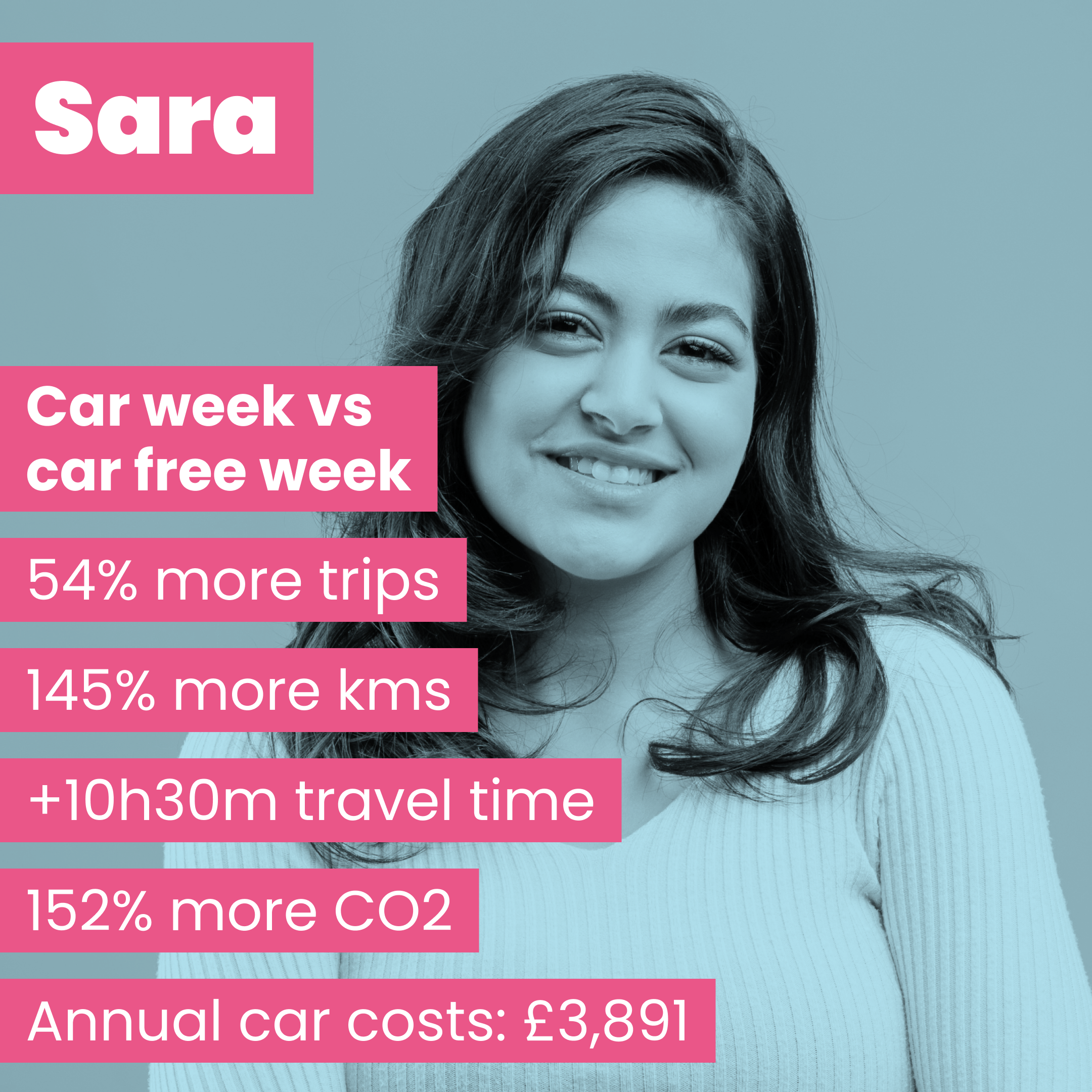
We have used a stock image to represent Sara to protect her privacy.
"I never walked before to my workplace, I’ve been working there for 8 years [..] In my mind it was something very hard, difficult to achieve, but absolutely not! And we managed to do lots of activities that I thought impossible to do without a car, but it is possible. My children were the sources of my energy and motivation, because they liked it so much."
-
As a student nurse and a single mum with young kids, Sara saw her car as central to managing her busy day-to-day life. She used her car for pretty much everything and made multiple car trips each day - getting to and from work and study, food shopping, ferrying her young children around the city, getting to her mosque, and to health appointments, as well as visiting family and friends.
At the same time, Sara was finding the congestion in Oxford more and more stressful, spending up to an hour every day in her car. She was increasingly concerned about the impact of pollution on herself and her young children, and hated seeing emergency vehicles get stuck in traffic.
When her car broke down unexpectedly, she took the opportunity to try out walking more, as well as trying buses and getting her and her children’s bikes repaired. Her family and friends were really supportive.
Sara absolutely loved the challenge - but not as much as her kids did! As a family, they spent more time together while walking to and from school, stopping in parks and playgrounds on the way. Sara said that her children were happier and more motivated from spending more time together outdoors, walking, talking and playing.
The thing Sara loved the most for herself was the health benefits she noticed. She got physically fitter during her three weeks taking part in the challenge, and had more headspace to reflect on life. Walking put her in a good mood and she enjoyed not having the stress of wondering where she was going to park. She spent more time catching up with her mum, as she often used her lone walks to call her.
Already a confident cyclist, Sara started using the cycle app Komoot to find a new route to work that avoided the steepest hills and busiest junctions. She found cycling to work particularly tough when the challenge overlapped with Ramadan and she was fasting, but is looking forward to cycling over the summer.
Sara was worried about how she was going to shop for her family without a car, but found that she could adapt by going to shops more local to her.
With her life being so busy, Sara did find that she had to spend more time planning how she was going to get around with and without her kids. She even had to get up earlier some days to leave time for bus journeys. However, her experience of buses wasn’t great. She found the app frustrating to use, and the timetables often didn’t match how long buses actually took to arrive. Bus routes didn’t go where she needed to get to when travelling out of town, and she didn’t like the loss of personal space when actually on the bus.
The hardest journey for Sara to switch turned out to be getting to some of her children’s activities. Because buses were unreliable, she had to try out taxis, but these were too expensive for her to do regularly. Cheaper, more reliable buses heading out of town, and less congestion on the roads, would have helped her out with these journeys. Sara found that a combination of walking, cycling and occasional taxis suited her busy family journeys more than relying on local buses.
Interestingly, Sara’s carbon emissions actually increased by about 3% per kilometre travelled during the challenge, and by 50% in total. This was due to her walking and cycling some of her journeys in the ‘baseline’ week, as well as having to make a number of longer taxi journeys in order to reach out-of-town activities with her children during the challenge, because of the lack of suitable alternatives. Even though Sara walked and cycled many of her journeys, these taxi journeys tipped Sara’s emissions over and above what she was doing before she tried to go car free.
So, can Sara go car-free? She’s definitely a lot more motivated, and feels great that she’s contributing less to the pollution and congestion in Oxford! The wellbeing benefits for the whole family have been huge: her kids loved the challenge even more than she did, and they’re all inspired to keep up walking and cycling so they can spend more time together.

“I [hired] a cargo bike for a week… I tried it with gardening stuff, compost and stuff, I went shopping with it. I transported a child - the child loved it. So yeah, it’s a very good means of getting around. Not particularly difficult because it’s electric so that was quite easy… The only downside is the cost… Maybe the government needs to subsidise cargo bikes."
-
Tim, a charity worker and dad in his 60s, learnt to drive growing up because it was simply what was expected at the time. However, these days, he doesn’t enjoy driving at all. He was really worried about air pollution and hated the levels of traffic in Oxford.
As a dad to two teenagers, including a son with disabilities, Tim mostly used his car to take his children to and from activities and for family errands and shopping.
Tim loved trying out new ways of getting around during the challenge, particularly the fun of renting different kinds of bikes including a cargo bike. He was able to use the cargo bike for getting around with his son, as well as picking up heavy shopping that he would have otherwise done by car.
To get to his job at a charity based on the outskirts of Oxford, Tim wanted to cycle because of the available ring road cycle path (and the lack of a bus on the same route!) He enjoyed cycling to and from work, but the poor quality of the cycle path made it less fun than it could have been.
What really changed things for Tim was the use of a cargo bike - which meant he could get around with his teenage son or a week’s worth of heavy shopping. Tim suspected before the challenge that he might save time cycling rather than driving - and he was right! He cut his travel time per kilometre travelled by 20%.
Tim pointed out that because Oxford is such an expensive place to live, many people with jobs in the city centre live further out and need to travel in and out of the city each day. This makes them reliant on bus services going to rural areas, which are unreliable and don’t cover a wide enough range of routes.
Tim’s experience of the challenge cemented his feeling that bus and train services are too expensive, and that privatisation is poor value for money. He thought that bus and train services need to be better integrated with each other, with higher taxes on increasingly large cars.
So, can Tim go car-free? With the help of a cargo bike, cutting most of his car journeys looks doable for Tim, even food shops and travelling with his kids - but a better quality cycle path and better bus services would help!

“I wanted to use my car a bit less because fuel’s quite expensive these days, but also I wanted to walk a lot more and Oxford is a perfect place to do it! There were a lot of positives... I walked a lot more, I walked routes that I’d never discovered before, I had a lot of fun with it."
-
Emma learnt to drive as soon as she could when she turned 17. Growing up in a small village, with shops a ten minute drive away and buses to school coming only once an hour, she wanted the independence of a car as soon as possible.
Despite moving to Oxford since then, driving every day had simply become a firm habit. Before starting the challenge, Emma spent about an hour most days in her car, getting to and from the office where she works in publishing or commuting along with her partner, doing food shops and getting around to see her friends.
Nonetheless, Emma’s motives for signing up to the challenge were strong! As an active person, she liked the idea of walking and running more. Sustainability was also a really big factor for Emma: she felt strongly about reducing our impact on the environment, and had a feeling that she could have been driving less if she tried out other options. She liked the idea of the accountability that would come with signing up for a structured challenge that other people were doing at the same time. Last but not least, with fuel becoming so expensive, Emma had noticed how high her car costs were getting, and wondered if she could save money by going car free.
As it turned out, Emma loved the challenge! She really enjoyed getting the extra exercise of walking more of her journeys. She tried out using a combination of walking and the bus to get to work and mostly found the journey simple and doable.
Emma had been worried about the impact of the challenge on her partner, as they often drove to work together. They got round this by getting the bus into work, or walking home together when possible. Another concern for Emma was how they would do their household shopping, but she adapted by walking to the shops more often, and getting a home delivery.
Emma was less keen on cycling or trying an e-scooter during the trial because of bad experiences she’d had on the roads, and because of how busy and unsafe it felt in Oxford. Quieter roads and dedicated cycle lanes separated from traffic would make her more prepared to cycle. In the longer term, cycle training or cycle buddy sessions, would help her to build up her confidence.
With the challenge taking place in March, Emma was often finishing work or leaving town when it was already dark in the evening. She didn’t feel comfortable walking on her own at night: she thought it was great that Oxford considered sustainability by not putting bright lights everywhere, but at the same time, it put her off walking after dark.
Emma cut her total carbon emissions from transport by a brilliant 60%, and cut her emissions per kilometre by nearly 30%!
So, can Emma go car-free? Now that she’s given it a go, Emma’s discovered that most of her journeys can be switched to car free alternatives pretty easily! She’s planning on keeping up with walking and running, and getting the bus to most places.

“I don't think that many people who have mobility issues would have been volunteering [to go car free]. And I think that's something that whoever's making policies about travel really needs to have at the forefront of their minds.”
-
As a doctor, an Oxford resident and a woman with reduced mobility, Nicole was interested in taking part in the challenge because she wanted to investigate and highlight the barriers for disabled people travelling around the city.
Working up to 72 hours a week, including thirteen hour shifts, night shifts and weekends, Nicole’s schedule was heavily impacted by her working life. Before having health issues that required surgery, Nicole had cycled most of her journeys and loved the fresh air and exercise she got from it - even on either side of a thirteen hour shift! The exception was for night shifts, when the additional time spent cycling took away from much needed sleep. At the end of each run of night shifts, Nicole made a special effort to take her bike, because cycling home in the fresh morning air felt like getting to the finish line of a marathon.
Since her mobility had been reduced, Nicole needed to drive virtually everywhere - because of the additional time and energy involved in using public transport, as well as the falls hazards presented by getting around on buses and trains. When she took up the Car Free Challenge, though, Nicole was open to trying out public transport for the majority of journeys, as well as car sharing with friends, to shine a light on the issues. Another factor was finding that her stress levels went up when stuck in traffic.
Although Nicole thought that the challenge had been set up and run well, her experience of trying to live without a car wasn’t easy.
On top of the extra physical effort involved in getting to a bus stop compared to getting in the car, Nicole found relying on public transport much more time consuming compared to driving. Our analysis found that her speed of travel fell by 35% without her car. This had a huge impact on her life as a whole: she was more tired, her routine was disrupted and limited, meaning that she had fewer opportunities to be active, spend time with others, and get her work done.
The vinyl floors of local buses proved to be incredibly slippery when it was raining: using walking aids was really unsafe at these times. Because of hazards like these, friends and family were more concerned about Nicole’s safety during the challenge than they were when she was using her car.
From her previous experience, Nicole thought that cycling in Oxford was really convenient, and that the city was better set up for cycling than other places she’d lived and drivers were unusually respectful and careful of cyclists despite sadly hearing about collisions in the news occasionally. However, she felt it was important that efforts to help people travel more sustainably didn’t solely focus on cycling.
Generally, Nicole’s interested in the benefits of shifting to a more sustainable transport system, particularly for our physical health. She thinks that it’s important to reduce car journeys as a whole, but also that we recognise that eliminating car journeys isn’t possible for everyone. Ultimately, the lack of accessibility in the current public transport system will remain a major barrier to helping more people, especially those with reduced mobility, travel more sustainability. As well as improved accessibility, Nicole wants services to be more reliable and more affordable. Nicole believes that just like not everyone may want to or be able to become fully vegetarian but should be able to eat less meat, we can all reduce our car use.
So, can Nicole go car-free? For journeys in and out of town with direct bus routes, Nicole would definitely consider it in the future. But while she’s reliant on crutches, going without her car isn’t practical for Nicole.

"Driving around Oxford is a pain… so sitting on the train and relaxing was quite nice for my daily commute. I wanted to prove to myself that it can be done… Train travel is expensive for a short distance, but it’s also very convenient. So hopefully there can be work done, you know, improving that… One thing I didn’t know about was buying a flexi ticket for the train.”
-
Richard’s been familiar with the need to reduce car journeys for a long time, and as a driver, cyclist, and pedestrian, he didn’t like that reducing traffic had become a ‘culture war’. A couple of years before he took part in the challenge, he and his family had already gone from being a two-car household to a one-car and one-e-bike household. Before the challenge, he still used his car for commuting to his job outside Oxford, and for errands and family trips like shopping, picking up children, and visiting family around the UK.
On the days he went to the office, Richard was spending one to two hours in the car getting there and back, so one of his first challenges was working out a car free commute. He decided that he could save time by cycling to the train station, taking his bike on the train and cycling at the other end.
As a very confident cyclist before the trial, Richard was prepared to take this on - but the quickest routes to the station were also the most dangerous, taking him on the busiest main roads at rush hour.
Trickier for Richard and his family were longer journeys to visit family around the UK - journeys that involved two kids and luggage. They tried out trains, but there weren’t always convenient routes. When there were, it was inconvenient with kids and luggage, and the journey took twice the time. Buses weren’t easy with kids either: Richard had recently tried getting on a bus with a pram, and had had a bad experience when he wasn’t allowed on.
Throughout the challenge, Richard found himself having to plan ahead more and going to the supermarket less often. He found it a bit limiting having to make sure he left the house exactly on time if he wanted to make a train or bus - rather than a car journey which could start any time.
The price of trains was off-putting too. Because Richard had invested in his own car, and had already paid upfront and annual costs like purchase, insurance and VED, he was only comparing the cost of train tickets against the cost of fuel for the same journey - so driving appeared to be cheaper on a day to day basis. Richard looked into season tickets, but the typical season tickets didn’t suit people who work a ‘hybrid’ pattern, who only travel into an office once or twice a week. However, he discovered that he could buy a ‘flexi’ season ticket: a block of eight tickets that could be used over a 28 day period, which suited his work pattern.
Despite finding available cycle routes and trains far from perfect, Richard enjoyed the challenge and says he’d totally recommend it to other people. Most people, he thinks, would find out that using their car less is totally possible and achievable. He noticed that friends saw the idea of going ‘car free’ as a massive inconvenience, but he actually found it liberating and felt more present in the world around him when he wasn’t in the car, enjoying more time listening to podcasts or just enjoying a coffee. One thing he liked about the challenge was that it gave him a chance to have more casual conversations about shifting away from private cars with his friends, family and colleagues.
Added to that, Richard made a huge difference during the challenge - he cut his transport emissions by more than 70%!
So, can Richard go car-free? He and his family will keep their car, but the challenge has boosted his confidence about getting out without it. He’s going to carry on doing his commute by bike and train; and he’ll use the family e-bike for shopping trips when weather permits. And, as his challenge stats show, he’ll still be making a huge difference!

"I wanted to do the car-free challenge more as a personal challenge for myself. I think I always knew that I should use the bike more and [be] more environmentally friendly... so I thought if I was doing it as a group, I would stick to it a bit more. And also just to help the traffic situation in Oxford because it is really, really bad, just constantly getting stuck in traffic every evening is really frustrating. So just to make the city a bit less congested, that was the goal... I think I'll definitely try and use the bike a lot more because I did feel a lot better those few weeks. I’m glad I did it."
-
Ellen learnt to drive in 2021 when she came back to the UK after living abroad, because she felt it was something she should get around to now that she was in her mid twenties.
Ellen’s schedule as a secondary school teacher at an Oxford school meant that she was at work from 8am to at least 5pm, from Monday to Friday - and often continued to work in the evenings when she got back, too. She always drove the 3.5 mile journey from home to work, and also used her car for going shopping and travelling around the UK, especially to visit her family in County Durham.
Despite her busy schedule, Ellen was motivated to take part in the challenge because she was tired of the congestion in Oxford. She felt that she was worsening the problem by driving her 3.5 mile journey to work - the traffic was so bad in the mornings and evenings that this journey would often take 45 minutes.
But, as a confident cyclist, she also felt she had the ability to be part of the solution. When the challenge came along, she felt it was something she should have been doing anyway, and it gave her the motivation to get back on her bike (and get it fixed up too). Her family and friends were supportive, but some - especially her mum - worried about her safety cycling to work through central Oxford.
Ellen’s experience of cycling was mostly good: she’d been a confident cyclist before the car free challenge came along, and enjoyed proving to herself that she could change her habits. But her cycle route didn’t always feel safe: the behaviour of drivers around her sometimes felt dangerous, and potholes put her at risk - forcing her to stop suddenly or change direction, going towards traffic.
As the challenge went on, Ellen did find it harder to keep up her motivation to cycle to work after a long day’s teaching, especially in bad weather and with a big hill to get up. However, the fact that her journey time was always roughly the same when she was on her bike helped her keep going, rather than the gamble of not knowing how bad the traffic would be if she were in her car. Later in the challenge, she used the e-scooters more, which she found were convenient and really good for getting up hills.
Ellen did use her car a couple of times during the challenge, when she did long distance journeys for work or to visit family. She couldn’t see a realistic alternative route by public transport - trains were unreliable and very expensive - and taking her car was easier and familiar.
Ellen wasn’t the only participant to reflect on how owning her car felt like ‘sunk costs’ when it came to deciding between using her car or not using her car. Because she had already paid for the total cost of her car in 2021, and because she’d already paid her insurance and VED for the year by the time she did the challenge, it almost felt like a waste of money to her not to use her car.
Even with the long distance journeys by car during the challenge, Ellen’s efforts to get on her bike paid off. She slashed her total transport carbon emissions by more than 60%, and cut her emissions per kilometre travelled by nearly 20%! If this reduction was scaled up nationally, it would put the UK back on track to meet our climate goals in the transport sector.
So, can Ellen go car-free? She says she’s significantly less dependent on her car for day-to-day journeys now, and will keep cycling to work if the weather’s decent. She’ll probably keep using her car for long distance trips around the UK, because of the cost and unreliability of trains.

“Going through the green energy transition, we can decide whether we go on with business as usual… or we can look at a different future… So I think it's certainly the time to do that at the moment.”
-
As a scientist interested in the clean energy transition, James began to have a feeling that when it came to how he travelled, he wasn’t ‘practising what he was preaching’. Before the challenge, he drove for about an hour each day, often because irregular work patterns meant he was going into work at weekends or staying late in the evening. Like many other participants in the challenge, he grew up in an area with poor public transport services and no active travel infrastructure, so he learnt to drive aged 17 because he wanted the independence that came with being able to drive. When he moved to Oxford, he brought his car and his driving habits with him!
James really enjoyed the shift in his mindset that came from challenging himself to do something new, something he hadn’t thought would be as easy or enjoyable as it turned out to be. During his three car free weeks, he made new friends in the colleagues he talked to on the shuttle bus to work, and cycled routes that he hadn’t tried before.
James found that not being in his car was good for his mood. His car journey into work had often been stressful because of congestion, worrying he was going to be late and occasionally because of interactions with other drivers. On the bus, though, he found himself relaxing, starting his day by just watching the world go by; or talking to colleagues and even occasionally getting work meetings done! That depended on the bus turning up, though!
The journeys James knew would be the hardest to swap were the ones where he was carrying heavy stuff - in his case, that meant musical instruments as well as food shopping. He’d been a confident cyclist in the past, but he’d fallen out of the habit before the challenge. Once he got his bike fixed up, he had panniers added, and this helped with food shopping (and even picking up plants from the garden centre!)
The only negatives of James’ experience were about the bus service. There were times when buses didn’t show up, including when he needed to get to work on the weekends. Because the buses didn’t come very frequently, James also felt his lifestyle became a bit less flexible, especially in the mornings when he was under pressure to get to work and couldn’t risk missing the bus.
James’ experiment in going car free has cemented his feeling that there needs to be more investment in public transport in the UK - he noted that our transport system is poor compared to many of our closest European neighbours. At the same time, he’s excited about the benefits that better public transport would bring for our health, the economy, the environment, and even for community building.
And while we’re on the environmental benefits - James cut his CO2 emissions per kilometre during the challenge by a massive 43%! If scaled up across the UK, this kind of reduction would be utterly game changing for the UK’s transport emissions pathway.
So, can James go car-free? He did an incredible job during the challenge - so much so that he’s actually giving up his old car! (It helped that it failed its most recent MOT). He’s going to carry on walking, cycling and even scooting now, and the challenge has kept him thinking about how the UK can make the shifts that we need in our transport system. He really recommends the challenge to other people who are thinking about trying it out - it was fun, and helped him see things in a new light.
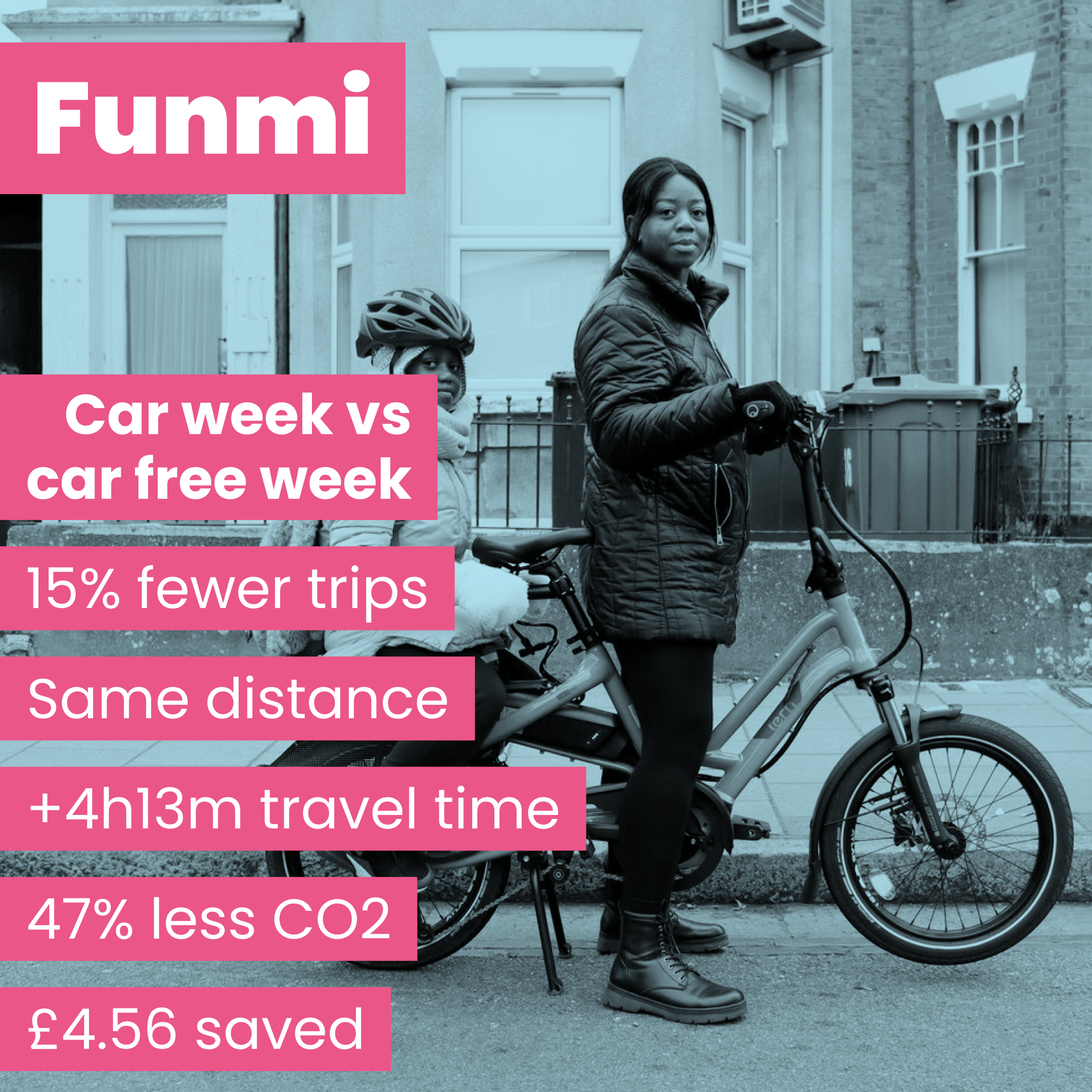
Funmi is in her 20s, lives in Stamford Hill, and is a single mum of one. She has a 2 mile school run with her 7 year old daughter Grace and a 5 mile commute to her part time job at a Tesco superstore. …
-
Funmi learned to drive when she was 18 and had always felt that it was her duty as a parent to be a driver. She felt that her daughter was safe and protected in the car, and that it was the safest way to travel, especially after dark.
Yet, when a fellow mum from Grace’s class shared the recruitment advert on the parents’ WhatsApp group, Funmi was intrigued by the idea of going car free. Driving had become more inconvenient since the introduction of numerous low traffic neighbourhoods in her area, and finding parking near her home was a hassle as there was no controlled parking for residents. Could she manage her regular trips without the use of her car? Funmi wanted to find out if another way was possible.
Carry Me Bikes loaned an electric Tern GSD family bike to Funmi so she could carry Grace on the back. Her previous cycling experience was limited to using hired Santander bikes in parks for leisure. So she had a few cycle skills training sessions with local instructor Earlyna Edwards, which really built her confidence - “I learned so much about positioning on the roads, observation, interacting with other road users”. Having practised the route to school in her training, Funmi was confident to cycle the school run and found that it was quicker than driving as well as more enjoyable. The LTNs and School Streets meant that the ride felt safe.
Because afterschool activities meant travelling in the dark in the winter months of the trial, Funmi and Grace initially replaced their car journeys to gymnastics and swimming lessons with bus journeys, because this seemed the less daunting option. They found that the time spent waiting around for buses was annoying! After another lesson with Earlyna to practise routes, discovering the pleasure of cycling along the River Lea and past the Marshes, Funmi used the Tern GSD for subsequent afterschool activities. She was surprised how safe the journey home in the dark felt, due to the segregated cycling infrastructure.
Funmi had to adapt to carrying the heavy bike up the steps to her flat as there was no other storage option. She got used to locking and unlocking the bike. The prep needed for cycling such as gloves, bike locks, became easier once it became her routine. She practised the route to work in one of her cycling lessons, but wasn’t able to commute to work by bike due to lack of secure storage at work - despite the Tesco superstore having thousands of car park spaces. The train provided a pleasant alternative but the cost was prohibitive in the long term. Funmi commented “I didn't need to think about going for a walk or going to the gym for exercise, because I was getting exercise during my commute, either by walking to the station or by cycling.” 7 year old Grace also enjoyed riding to school on the Tern and turning the heads of her peers by arriving on a stylish family bike!
The Tern GSD has gone back to Carry Me Bikes now, and Funmi is saving up to get bikes for herself and Grace in future. But once she is in a position to buy, storage of two bikes is going to be a challenge, unless Hackney Council urgently increases the number of cycle hangars in her area.

Michelle lives in Croydon with her partner/husband Mark and works as a trauma therapist in the Catford/Croydon area. Michelle’s car use largely came from her volunteer work at her church’s local food bank doing weekly deliveries, and making regular trips to Maidstone for work. Additionally, she has three young grandchildren and is involved in the care and school pick-ups for two of them….
-
Before the Going Car Free trial, Michelle hadn’t cycled for nearly 30 years. She had come to depend on her car for all of her journeys, even trips to the local shop, and she valued the comfort and convenience of driving, especially since there is an abundance of unrestricted, free parking in her borough.
As a self-described “petrolhead”, how would Michelle fare without her car for three weeks?
At the start of the trial Michelle said she felt “terrified” of leaving behind her car - a Mercedes with nice warm heated seats in winter. But she threw herself into the challenge and tried a range of alternatives: Electric bike, cargo-tricycle for the school run, trains, trams, buses and walking.
Peddle My Wheels loaned Michelle a cargo-tricycle for the school run and trips to after school activities. The children loved observing the changing seasons and became more aware of their environment compared to going to school by car. Michelle noticed that the journeys allowed them to interact and enjoy the adventure as they sat facing each other in the box. They were disappointed whenever Michelle came to pick them up without the cargo-trike.
Wheels for Wellbeing loaned Michelle an e-bike which she used for commuting to work. She did several journeys by public transport and reported positive experiences, particularly enjoying the switch to train journeys for her regular trips to Maidstone, as she found it relaxing and enjoyed being able to work or chat with her colleague on the journeys -”this is definitely the way to travel!”. Having previously driven to her friend’s house for a weekly social walk together, Michelle started walking some of her journeys and found it a great way to reflect and unwind after heavy sessions with clients, but she found she was constantly dodging dog mess on the pavements.
Michelle found going car free so liberating that she sold her beloved Mercedes and bought an e-bike instead. She now walks the kids to school, cycles to work, uses public transport more and says “We are so happy!”
Taking part made her think about her carbon footprint and impact of her travel choices on the climate.
Although the cargobike had to be returned, they now walk to school rather than using the car - since they don’t need to spend time looking for parking, it doesn’t take any longer than driving used to. “It was all about breaking the habit of driving everywhere”.
Discovering that you don't need special clothes to cycle; the benefits of a car free school run for the kids; feeling fitter all changed her perception on car ownership. After breaking the habit of driving, Michelle sold her car as a result of the trial and bought an e-bike instead. Now she shares her daughter’s car when she needs one.
Michelle spent the most on public transport and the most on taxis out of our participants. Also, the value of the cargo bike and e-bike loans contributed to the massive extra cost of Michelle’s travel during the trial.

A working mum of three (kids between the ages of 10-15), Julia enjoyed the freedom of being able to go anywhere whenever she wanted or needed to. The car wasn’t just for her; knowing that her kids didn’t have to wait at a bus stop, that they were safe in one piece and close by was important to her (understandably). …
-
Climate change does worry Julia, and as a family they try and make environmentally friendly choices - put their money where their mouth is. But when it comes to travel, the main barrier is the worry that they won’t be able to get to where they need to be without their car. As a family of five, there are a lot of appointments, after school clubs, sports, shopping, etc. and making that parental jump letting the kids travel alone sometimes is hard.
Julia was keen to look at options they might not have considered before and to really ask herself - do I actually need my car? She is also excited to help shape change in the city.
Whilst taking part in the challenge, Julia really threw herself into trying different sustainable travel options and didn’t use her private car at all! And whilst the buses were a real struggle for her (quite anxiety-inducing for a number of different reasons), cycling, the e-bike, and the car club were really exciting!
Julia found the e-bike to be a fantastic tool, stating that it was so much more accessible and much easier to use on all the hills. But the cycle paths in the city are wild, disjointed, and confusing. Although her kids learnt a lot about road safety and awareness, and became more confident cycling in the city, more needs to be done in terms of infrastructure and also other road users.
Julia was really taken with the car club - a big fan! It was really useful to be able to use a car on the one day a week where lots of family appointments fall. Having said this, it was quite a contrast to suddenly be stuck in traffic after three weeks of whizzing past on a bike. Julia really noticed how much car use affected her mood, compared to other more active forms of travel.
So, does she actually need her car? Well, after the trial, Julia found that they don’t need their car as much as they thought they did. And where previously she ferried her kids around everywhere, having them take the bus to school whilst she cycled to work freed her up a bit more - all she had to worry about was getting herself home and then enjoying a bit of extra free time to herself.
Has she gone car-free? Julia has sold her car, and her partner has swapped theirs for an electric one. Although feeling a bit anxious about selling her car at first, it now feels like a weight off her shoulders; not having to worry about petrol, tax, or repairs. Plus this frees up some money for their family to get solar panels!

A previously frequent Active Traveller found herself driving more and more on a daily basis when her family decided to get a camper van, which was initially only intended for day/weekend-trips out of the city. …
-
The convenience of using the van, coupled with feeling like you get to places faster, led to her becoming more and more reliant on it, even though Emma was aware of the environmental/climatic impacts of driving. Not to mention the road rage and sense of entitlement that driving brought her - completely juxtaposed with her true nature outside of the van!
She was interested to see how easy/hard she would find going car free now that she had become so dependent on driving in such a short space of time. Emma was also intrigued to learn what alternatives were available to her and actually accessible with a new four-month old baby.
Through the process of Going Car Free, Emma found herself enjoying the challenge of doing something different, learning about new bus routes, discovering the joy of e-bikes, and being able to travel and explore the city with her baby.
Where previously she would have been held up in congestion, getting frustrated and resentful, she now zooms through bike lanes, knowing that she’ll reach her destination quicker and happier!
Emma noted that when she was driving everywhere, her life was hectic. She rarely said “no” to events/meet-ups and would often drive to meet the other person. By using the van less, her life is less hectic, and when she does say “yes” to events/meet-ups, they meet halfway. The “convenience” of the van is nothing compared to the ease, and lower stress levels of going car free.

Nathanael is 35 and lives in the Troopers Hill/Crews Hole area of Bristol. This is quite a hilly area that is further than average from bus routes. Nathanael is a lodger, and has an 11-year-old child. He is a DJ with a radio show and loves walks in nature. He works as an Emergency Care Assistant in the ambulance service and so often works long shifts (sometimes 70-74 hours a week). …
-
Nathaniel owns a campervan that he generally uses to get to the ambulance station, a journey which isn’t feasible by bus for the hours he works. If his shift runs long, he can then stay on site and go straight into the next shift. He also works outside of Bristol (e.g. Falmouth, Torquay, Exeter) regularly to cover different ambulance stations.
Before the challenge, he already walked and used e-scooters for leisure activities. Nathanael was a Zero Car Use Hero, not using his car or indeed any car-based mode (Car Club, taxi, lifts) during the whole three weeks, and instead using a borrowed bike, Voi e-scooters and buses.
Nathanael thoroughly enjoyed cycling to work - he felt less stressed, enjoyed the exercise, and relished the opportunity to clear his head after work.
Nathanael is not ready to give up his beloved campervan for trips to see his family in Devon, but he’s loved the experience so much that he now wants to buy his own bike for his commute into work.

Shaheen is an NHS clinician, a single mum of two boys who is also doing a part time masters degree. Shaheen has an extremely busy schedule with up to 8 trips per day, including afterschool activities. Her neurodiversity means that Shaheen finds public transport stressful at times, whereas cycling helps her to manage her symptoms and reduces her need for medication. …
-
Before the trial Shaheen had already discovered the mental health benefits of cycling and enjoyed riding her Brompton bike several miles to college. But she felt dependent on her car for commuting to school, nursery and work and was frustrated by the time lost on driving around looking for a parking spot and the high costs of petrol. Keen to try alternatives to the car, Shaheen borrowed a Tern GSD family e-bike from Carry Me Bikes to see if it could work as a replacement for the car. Her boys loved the fun of being on the bike although Shaheen worried about them catching cold on the frosty days - warm gloves and hats were a must. The e-assist was great for zooming up the steep hills around her area and it was great to be free from parking stresses. But living on the 9th floor of a block of flats with no secure cycle storage meant that disassembling the child seat and panniers and wrangling the bike into the lift every day was tiresome on the days that they had several trips to make. Taking down the bike and setting it up also added 15 minutes onto the time needed to get to school. Secure cycle storage would have made a huge difference to Shaheen’s experience, which highlights the need for proper cycle storage on housing estates.
Since the trial ended and the Tern went back to Carry Me Bikes, Shaheen and her sons have been walking and cycling more, having realised that many locations were closer than they’d realised. And with the imminent introduction of a School Street at her son’s school (where through traffic is not allowed at school pick up and drop off times, they have even more incentive to cycle to school and find it less stressful than driving. The Brompton is now fitted with a child seat for the youngest son and the eldest son rides his bike (which has been adapted by disability charity Reach to suit his congenital hand difference) Shaheen then continues on to work at the hospital on her bike.
The trial helped her to experiment with different transport modes and she’s become more confident taking her Brompton on the train for some journeys, overcoming some of her anxiety about public transport. A family e-bike is still on her wishlist having experienced the benefits - along with some thermals for her boys for those cold winter journeys!
The need for secure cycle storage on estates/ social housing; Women’s trip-chaining; city planning for local journeys not just radial ones; designing cities for children; family e-bikes an an alternative to owning a car
Shaheen’s shift to cycling meant she spent no money during the trial. Shaheen was a Zero Car Use Hero over the trial, not using the car or any car-based mode at all.

Hannah is 25 and lives in Brislington in south-east Bristol. She works long hours as a recruitment consultant in Clifton from 8am to 6pm, and sometimes longer. She uses her car for most journeys but considers it a bad habit. …
-
Hannah is really aware of the environmental crisis, she knows private cars contribute to the problem, and she also recognises that driving is a stressor that causes road rage, so she took on the challenge to try to drive less.
During the challenge, Hannah predominantly walked and used the bus.
Overall she was surprised to find it fairly easy to get to work with convenient bus routes there and back. She noticed feeling more relaxed and enjoyed the extra time she could use to prep for work. However, she found that using public transport required a lot more pre-planning, and could occasionally be unreliable.
She also rediscovered her local shops were just a 10 minute walk away. She realised that she did not need to drive these short journeys as she had gotten into the habit of doing. But she also expressed concern about walking longer distances alone in the cold, dark nights of January.
On the first week of the challenge, Hannah witnessed a bus collision with a cyclist and she didn’t use a bike, e-bike or e-scooter during the challenge largely due to lack of experience and concerns about road safety. Hannah felt that more protected cycle lanes in Bristol would make her want to try cycling or e-scooting.
Hannah sees her car as a safety net, and whilst she isn’t ready to give it up just yet, she says the trial made her realise she doesn’t need it for all journeys: “I don't actually need to use my car all the time, and it is probably a lot easier and quicker to walk quite a lot of the time… for smaller journeys, going into the town centre… I could get the bus for things like that.”

Joe is 40 and lives with his wife and two boys aged 7 and 4 in a house in Bournville in South Birmingham. He works shifts as a firefighter near the city centre. He has owned a car all his adult life and at the start of the experiment they were a two-car household. …
-
Before the trial, they had considered getting rid of one car, and were participating to explore how possible this was. Joe often walked or cycled to work before the trial, and walked the children to school.
Joe found that the car-free weeks required more planning, especially thinking about what might need to be carried, and that it was harder to take spontaneous trips. He did find that Voi e-scooters enabled a lot more spontaneity as they could make one way trips, and that they were still fine to use in the cold. He also used them in preference to cycling, especially as they were available for free during the trial. However, it wasn’t possible to use an e-scooter at night, so he would use a public hire (Beryl) bike instead.
Being near to the cycle lane network helped with using the scooters and bikes. He also found that walking home after a late shift was pleasant but meant spending less time with family as he’d get home later. He also didn’t use public transport much during the trial because of reliability issues, finding e-scooters and cycling more convenient, and the Car Club appropriate when having to carry things. They found that their car use tended to be around moving the children. One of Joe’s trips involved wanting to use a Car Club car, and this was abandoned when one wasn’t available.
They have decided to replace their second car with an electric one, and then sell their first car to go down to being a one car household, despite having the largest cost increase per week of all the participants.

Kate is 39, and lives in St George in Bristol with her husband and her 4-year-old daughter. She works part-time from home on most days for the Environment Agency. Kate was sceptical about using buses ahead of the challenge because of previously uncomfortable experiences due to her disability. …
-
Sadly, there were some more negative experiences, with bus drivers pulling away before Kate and her daughter could sit down, leaving Kate with a minor injury. This trial confirmed to Kate that buses in Bristol need to be vastly improved with better training for drivers, better routes, better service, and they need to be more cost efficient. However, Kate enjoyed the flexibility of using the Voi e-scooters to run errands.
One of Kate’s biggest frustrations was planning, particularly for weekend trips out with her family, with some frustration about the limitations but she enjoyed using a car club car to facilitate this.
Since the challenge, Kate thinks she will use the Voi e-scooters more as the perfect solution for longer distances that are harder to walk: “They’re actually more quick and convenient than the car for some journeys.” She is also more likely to use a car club now that she knows how they work. Kate has gone on to actively campaign for a school street around her daughter’s school.

Faith is 42 and works full time at the University of Birmingham. She lives with her partner and 3 of her 4 children in Bournville and commutes to work in her 1996 camper van. She only learnt to drive around 4 years ago, then started using the car for almost all of her trips, though having been a two car household, her disabled partner has given up driving due to disability. …
-
Faith found that already doing most of their grocery shopping online helped with being able to participate in the trial . Their normal travel patterns included using the camper van for the school run, commuting, and going to the shops on the way home. They often made evening leisure trips in the car as well, often to the park or cinema, as well as collecting second hand items.
During the trial, one of the main problems was the logistics of travel to medical appointments for her partner, and that the bus wasn’t very convenient for travel to school. However, she mentioned that walking her son to school and taking an e-scooter back during the trial made things easier. On the other hand, bus reliability during rush hours was a major problem and she decided to walk sometimes carrying shopping when a bus wasn’t turning up. The e-scooters turned out to not be practical for shopping trips.
The biggest issue during the trial was planning a day trip for the family but finding the trains were cancelled, so ending up having to drive while also having paid for the tickets. This was a big contributor to them having spent more overall.
Since the end of the trial, she has continued to walk her son to school, and now finds herself questioning whether she should use the car for many trips. She now frequently uses the e-scooters to commute to work, finding that they can be faster than driving. Before the trial, they were considering a return to being a two car household, but that this may not happen now. She would also like to continue walking more.
Faith would like to see pavement parking restricted and less clutter from bins on the street, and would use the bus more if children travelled free. She thinks more positive encouragement for people to use their cars less would work better than restrictions.