
Guest post: Growing accessibility on our streets – one tree at a time
By Kate Ball - Wheels for Wellbeing
Eco-accessibility - well-planned tree planting is essential for both accessibility and sustainability
Wheels for Wellbeing is a Disabled People’s Organisation working to improve accessibility of walking/wheeling, cycling and multi-modal journeys for all Disabled people.
We want everyone to have the opportunity to move around our communities, in ways that work for us. Greener, shadier streets are a critical part of this work.
We believe public space and environmental measures cannot work well unless they are accessible – and public space accessibility cannot work well unless it is sustainable. This is what we mean when we use the term 'eco-accessibility'.
New research from University of Westminster and Possible helps to highlight how eco-accessibility can be achieved to create streetscapes that work for us all.
Sustainability is important for everyone. It’s most important for Disabled people.
Disabled people are at greater risk than non-disabled people from extreme heat and cold, air pollution and flooding– and from all the other serious consequences of climate breakdown, including potential disruption to services such as healthcare, transport, water and power (1).
Disabled people are more likely to be made ill by extreme heat and cold, often due to factors related to our disabilities.
Disruption to transport and power can mean that critical services such as care and healthcare do not happen.
Disabled people are less likely to be able to get to emergency provisions such as warm or cool shelters and bottled water distribution than non-disabled people.
To make local active travel and public transport options work for everyone and to reduce the impact of climate change, sustainability and accessibility go hand in hand.
In summer, trees provide shade and have a cooling effect on all the spaces and buildings near them (2). Summer cooling from trees could make the difference between a Disabled person being able to support their children, get to work, or attend appointments, exercise and socialise – or being stuck at home, hoping to avoid immediate illness due to heat but at greater risk of long-term ill health from inactivity, poverty and isolation.
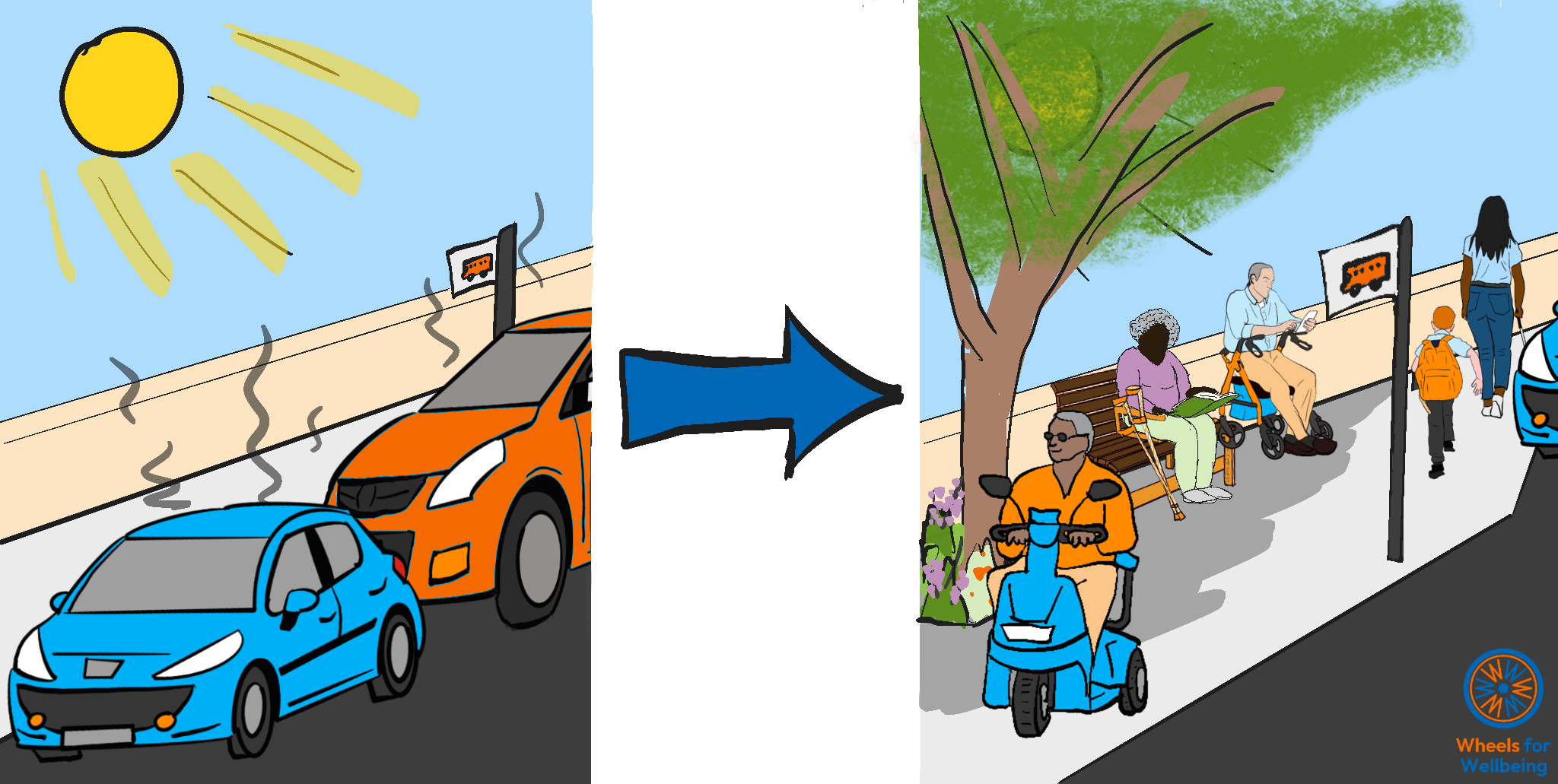
In winter, even leafless trees provide seasonal shelter for walking/wheeling to the bus stop. Pausing to wait out a springtime downpour under verdant new leaves can make all the difference to a journey: it’s more pleasant to be dry for everyone, and for some Disabled people this shelter can help reduce risk of serious health consequences, such as skin breakdown and pressure ulcers, or hypothermia.
During rain, or when snow is melting, trees and other well-designed green spaces absorb water, preventing flooding in the local area and downstream (3): People who need to use dropped kerb crossings are less able make trips when crossing points flood, because we cannot just go around the water. For example, most powered mobility scooters cannot be driven through deep puddles. And since there is a severe nationwide shortage of accessible homes (4), when homes flood, it will be almost impossible for Disabled people to find accessible temporary accommodation: reducing flooding is incredibly important for Disabled people.

Two illustrations side by side showing impact of kerbside greening. Image on left (with no greening) shows pedestrian on pavement in the rain and getting splashed as car drives through large puddle). In the image on the right two trees provide some shelter from rain, and there is no puddles because water has been absorbed by kerbside greenery.
Trees and other plants can help reduce air and noise pollution, especially in combination with designs for driver speed and volume reduction – helping to reduce ill health, from asthma and chest infections to increased stress and heart attacks.
And trees bring joy and connection, too. Tree planting on streets and open spaces is especially valuable for Disabled people, who presently have much less access to natural spaces than non-disabled people (5). We are less likely to be able to make long journeys, and more likely to live in poorer areas, which typically have fewer trees (6) – calling wealthy areas “leafy” is, sadly, accurate, as is its opposite.
From social contact with neighbours on green local streets and open spaces, to the enjoyment of watching leaves unfurl, birds nesting, and bats darting between dim branches, trees are hugely beneficial directly to us and to our planet’s health.
So, we need more trees on streets, and we need to plan, plant and manage them right.
Why well-planned tree planting is essential.
Too often, when we think of trees on streets, we think of dangerous, broken, narrowed pavements. Poorly planned or maintained tree planting makes spaces less accessible and reduces the wider benefits that trees provide. For example, inadequate planting design can reduce a tree’s ability to absorb rainwater, and restricted growing conditions can limit tree health, growth, and shade cover.
Fortunately, brilliant tree-planting resources are available to help planners, designers and campaigners work out which trees and other planting will work well in different areas (7).
We need more trees in our streets, but they must be planted thoughtfully. Pavements must have at least 2 metres of clear, usable width at all times (8, 9).
As Possible and Active Travel Academy’s new report makes clear, trees on kerb build-outs are excellent accessibility measures, and they also improve street safety and accessibility by encouraging slower driving, reducing dangerous pavement parking and creating space for measures like benches and cycle parking.
Kerbside greening is just the start: Replacing eco-ableism with eco-accessibility
We need green, shady spaces which help manage temperatures, reduce flooding, create shelter, and enhance biodiversity across our towns and cities.
But to achieve accessible public spaces, we need to address a real problem: Far too often, both in public discourse and in project design, accessibility and environmentalism are pitted against each other rather than being seen as the partners they truly are.
Poor accessibility of “street improvements” is all too common, from planters placed blocking dropped kerbs, to trees damaging pavements, to local green spaces with inaccessible entrances and unusable paths (10).
Disabled people are too often told by authorities and environmental supporters that the inaccessibility they’re experiencing from schemes doesn’t matter, won’t be corrected, or even isn’t real. This is called 'eco-ableism' and it represents a real threat to truly sustainable placemaking .
Inaccessible schemes aren’t just discriminatory, they are less effective at improving sustainability.
At an individual scheme level, excluding a large proportion of people from moving around their local area perpetuates both isolation and car dependency. Beyond that, inaccessible schemes create suspicion and hostility towards all environmental, sustainable measures, making it more difficult for high-quality future schemes to be developed.
This research from Possible helps show how we can replace environmental defeatism, motonormativity (11) and eco-ableism with eco-accessibility, where public spaces will only be considered sustainable when they are accessible for us all.
Stein, P.J.S. and Stein, M.A. (2022) ‘Climate change and the right to health of people with disabilities’, The Lancet Global Health, 10(1), pp. e24–e25. doi: 10.1016/S2214-109X(21)00542-8.
Friends of the Earth (2023) The cooling effect of trees and green spaces in cities. Available at: https://friendsoftheearth.uk/climate/cooling-effect-trees-and-green-spaces-cities (Accessed: 8 September 2026).
Learn more about how greenery in urban spaces absorbs water and reduces flood risk at https://www.ciwem.org/policy-reports/sustainable-drainage
Levelling Up, Housing and Communities Committee (2024) Disabled people in the housing sector. Seventh Report of Session 2023–24. House of Commons. Available at: https://publications.parliament.uk/pa/cm5804/cmselect/cmcomloc/63/report.html (Accessed: 8 September 2026).
Activity Alliance (2025) ‘Increasing accessible outdoor spaces is good for everyone’. Activity Alliance, 28 July. Available at: https://www.activityalliance.org.uk/news/10042-increasing-accessible-outdoor-spaces-is-good-for-everyone (Accessed: 8 September 2026).
See Tree Equity Score UK.
Transport for London (2010) Pedestrian Comfort Guidance for London: Pedestrian Comfort Level Guidance. First edition. London: Transport for London. Available at: https://content.tfl.gov.uk/pedestrian-comfort-guidance-technical-guide.pdf (Accessed: 8 September 2026).
Wheels for Wellbeing (n.d.) Defining accessible surface areas for active travel and public spaces. Available at: Wheels for Wellbeing webpage (Accessed: 8 September 2026).
Transport for All (2023) Are we there yet? Barriers to transport for disabled people in 2023. Available at: https://www.transportforall.org.uk/blog/2023/12/05/are-we-there-yet-barriers-to-transport-for-disabled-people-in-2023/ (Accessed: 8 September 2026).
Walker, I. and te Brömmelstroet, M. (2025) ‘Why do cars get a free ride? The social-ecological roots of motonormativity’, Global Environmental Change, 91, article 102980. doi: 10.1016/j.gloenvcha.2025.102980.